
From Cleanup to Continuity: Kayak Island
In 2024 and 2025, Ocean Plastics Recovery Project returned to Kayak Island, Alaska after nearly a decade of absence from large‑scale cleanup efforts. The work there confirmed our long-held suspicion that Kayak Island is one of the most heavily impacted shorelines in the United States for marine debris—and one of the most important places to understand how that debris moves, accumulates, and can be responsibly collected. The dramatic cliffs of Kayak Island and the historic Cape St. Elias Lighthouse reinforce its role as a “sentinel site” for monitoring the health of oceans and coasts.
In 2026, we are launching a fundraising campaign to support a third consecutive return to Kayak Island, marking a transition year as we begin shifting toward private funding—first through philanthropic support and ultimately through ecosystem restoration funding. This next phase is about more than cleanup. It is about continuity, science, accountability, and ensuring that hard‑won progress does not stall at the moment it becomes most meaningful.
What We’ve Accomplished So Far
An historic removal effort in Alaska.
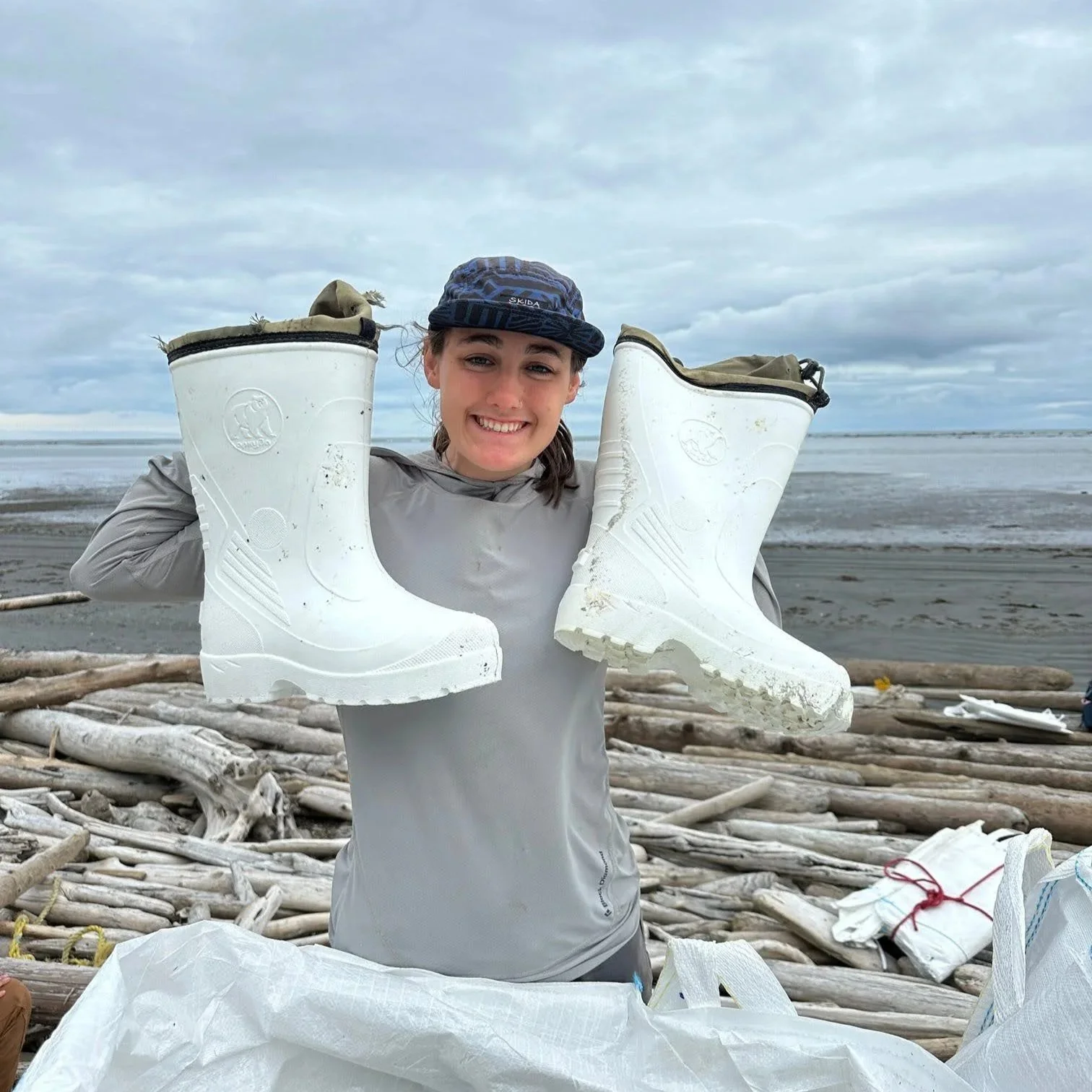
Over the past two years, we’ve removed more than 171,000 pounds of marine debris from Kayak Island—one of the most significant hand-collected removals in the United States. Working in an extremely remote, logistically complex environment, our crews lifted massive volumes of legacy debris from Kayak Island’s exposed shores—material that had accumulated for decades and posed ongoing risks to wildlife, navigation, and coastal ecosystems.
A rare two-year time series after nearly a decade of inactivity.
Large-scale cleanups on Kayak Island are rare. Prior to our return, the island had seen almost ten years without systematic debris removal. By committing to consecutive seasons in 2024 and 2025, OPR established something far more valuable than a single cleanup: a two-year time series that allows us to observe change, not just impact.
Documenting one of the highest reaccumulation rates on U.S. shores.
In our second year, we were able to precisely measure how much debris reaccumulated after the initial cleanup. The results point to a reaccumulation rate believed to be among the highest documented anywhere in the United States, averaging more than two tons of debris per mile annually and that the eastern side of the island alone is receiving 80,000 lbs per year. This finding reinforces Kayak Island’s importance as a monitoring site and underscores why one-off cleanups, while necessary, are not sufficient on their own.
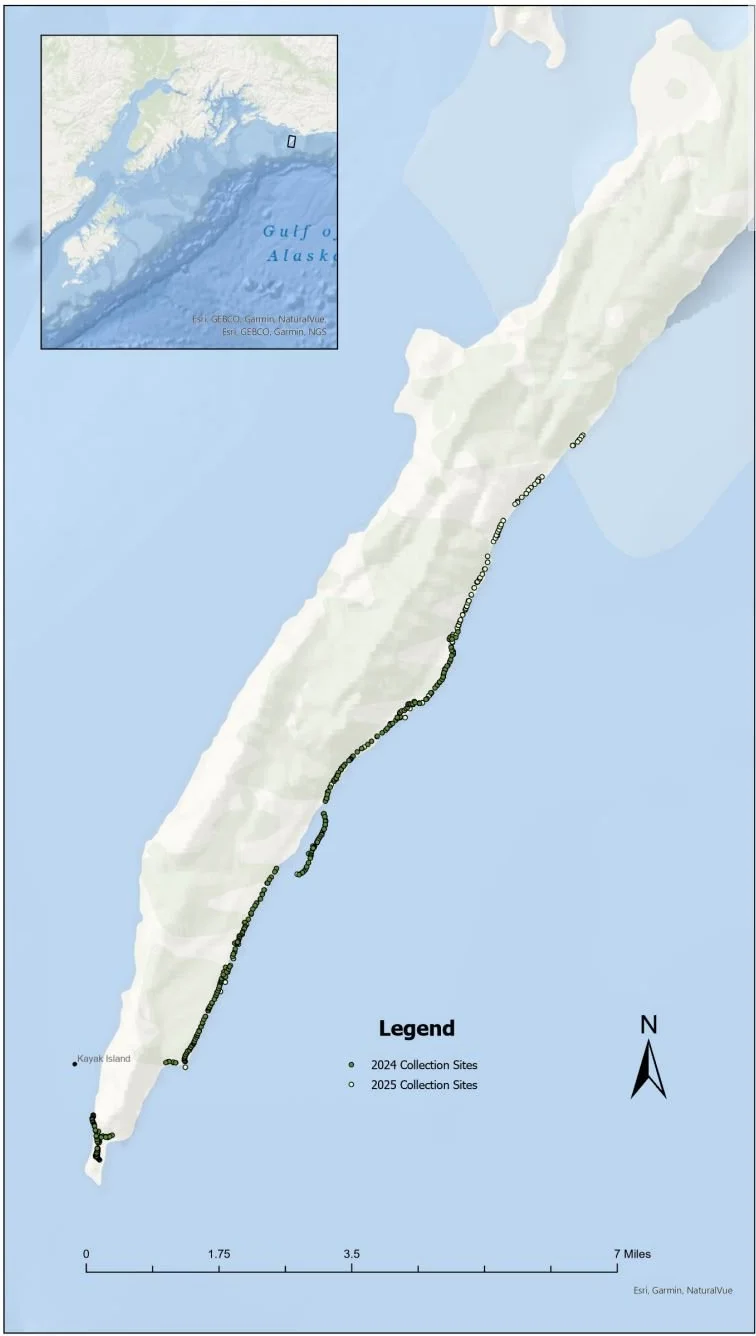
In 2026, OPR will prioritize a third consecutive year of cleanup across the 6.8 miles restored in 2024–2025 to maintain data continuity, then expand to an additional 2.3 miles first cleaned in 2025. This approach extends monitoring to all of eastern Kayak Island, estimated to receive over 40 tons of ocean plastic annually.
Why This Work Matters Beyond Kayak Island
Our work on Kayak Island isn’t just about removing debris—it’s part of a much larger effort to understand and quantify the real value that ecosystems provide. As our advisor Nina Butler recently wrote in her piece From Ocean Gyres to Economic Design, one of the barriers to effective environmental action today is that nature’s contributions have historically been treated as outside of economic systems, even though they deliver vital services like climate regulation, nutrient cycling, and biodiversity support that underpin our economies and well-being. While organizations such as +Nature and Blue Green Future are advancing the essential work of ecosystem valuation, OPR’s role is complementary and deliberately practical: we anticipate those valuation frameworks by supplying a missing, actionable data point—the measurable impairment caused by plastic pollution. By quantifying how plastic gradually degrades ecosystem function, our work translates ecological value into concrete loss, grounding valuation efforts in observable, repeatable evidence.
As ecosystem valuations are developed, the costs of impairment clarified, and the effectiveness of removal documented over time, we can look ahead to a durable revenue stream for ocean plastics removal. When the damage plastic causes to ecosystem services can be priced, and when the value of restoring those services can be demonstrated, cleanup is no longer a charitable act alone—it becomes a measurable intervention with economic relevance. In that future, removal is not just remediation but a form of ecological repair—eligible to be financed, contracted, and sustained alongside other environmental services. The work on Kayak Island is helping lay the groundwork for that transition, ensuring that ocean plastics removal can ultimately stand on a foundation of accountability, performance, and value creation rather than episodic grant funding.
A path to sustained funding is visible on the horizon, but we’re not there yet. The federal support that enabled the 2024–2025 Kayak Island cleanups has now ended, and funding availability for 2026 is significantly reduced. This shift highlights the importance of private support to sustain the work and ensure continuity of data collection, monitoring, and debris removal in one of the nation’s most critical sentinel sites.
What Comes Next
Our goal is to raise funds to return to Kayak Island in 2026 for a third consecutive year—a milestone that would transform an extraordinary effort into a sustained, defensible program.
The 2026 campaign is designed as:
One month of on‑the‑ground cleanup, in June/July, focused on priority shorelines identified through prior years of monitoring.
Paid, professional crews, supported by helicopter operations and specialized vessel subcontracts to safely access remote beaches.
Responsible material handling, with recovered debris transported back to the OPR Innovation Center in Kodiak, where it undergoes intentional measurement, analysis, and reporting—informing downstream innovation, research, and system design—before being recycled.
A third year allows us to refine reaccumulation models, validate assumptions, and strengthen the scientific and policy relevance of the work. It also sends a clear signal: Kayak Island is not an isolated project, but a long-term commitment to understanding and addressing marine debris at its source and along its pathways.
What We Need
Support for this critical next phase is now being sought from partners who share our vision for sustained ocean plastics recovery. Your contribution will directly support crew wages, aircraft and vessel operations, material transport and processing, and data collection and reporting.Your charitable support does more than fund a cleanup. It sustains one of the most important marine debris monitoring efforts in the United States at the moment it becomes most consequential—when data, continuity, and credibility converge. It allows us to keep measuring impairment, refining solutions, and demonstrating what effective recovery looks like in places where plastic pressure is relentless.
This campaign is an invitation to help carry that work forward. By supporting Kayak Island in 2026, you are not only helping remove plastic from one of Alaska’s most impacted shorelines, you are investing in the knowledge, accountability, and economic logic needed to make ocean plastics recovery self-sustaining. Together, we can ensure that Kayak Island continues to tell this important story.
Author’s Note: A previous version of this article incorrectly stated that the Kayak island cleanup was "the largest cleanup on Alaska's coast during that period [2024-2025].” We have changed that language to characterize it as “one of the most significant hand-collected removals in the United States.”
We could not have come this far without the support of our partners. The Kayak Island effort was originally funded by NOAA Grant NA23NOS9990088 to University of Alaska with subaward UAF 24-0041 to Ocean Plastics Recovery Project (OPR). The project received permitting and guidance from the U.S. Forest Service (Authorization ID COR491). OPR’s work at Kayak Island has been considerably strengthened by supplemental funding from the Martin-Fabert Foundation, a fiscal sponsorship by Realize Impact, and in-kind contributions from Island Trails Network, the Cape St. Elias Lightkeepers Association, and the Marine Exchange of Alaska.